What is the speed ratio? Why does a truck with a small speed ratio run faster?
Why is the climbing ability with high speed ratio stronger? How do we choose?
We often hesitate when buying a truck, is the rear axle speed ratio higher better or smaller better? In fact, each has its own advantages and disadvantages, and the key is suitability.
Many people may know that smaller the rear axle speed ratio is, the smaller climbing force is, the faster speed is, and the lower fuel consumption is.
When the rear axle has a large speed ratio, the climbing force is stronger, the speed is slower and the fuel consumption is also higher.
The rear axle speed ratio is an important parameter of the engine, and the academic name is the main reduction ratio. The rear axle speed ratio is the gear ratio of the main reducer in the automobile drive axle. It is equal to the ratio of the rotational angular velocity of the drive shaft and the rotational angular velocity of the axle shaft. Actually, it is the number of teeth of the driven gear of the final drive divided by the number of teeth of the driving gear of the final drive.
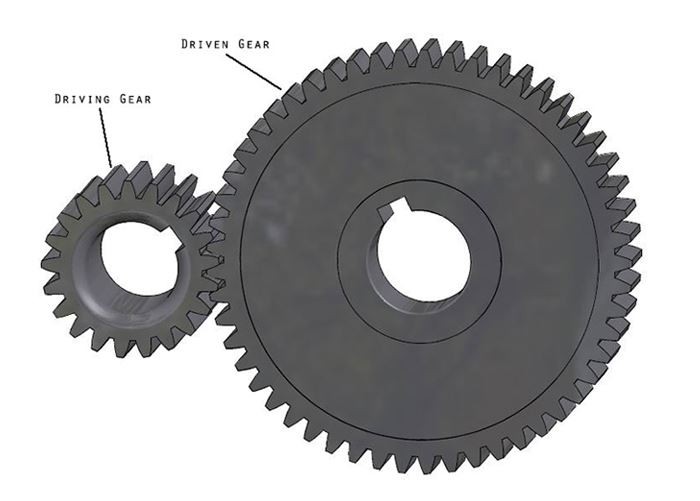
For example, some models of our GIGA VC61 heavy truck has a rear axle speed ratio of 5.571. How does this 5.571 come from? The number of teeth of the driven gear is 39, and the number of teeth of the driving gear is 7, so 39÷7≈5.571, and the rear axle speed ratio is 5.571
It can also be said that the drive shaft rotates 5.571 revolutions to drive the half shaft to rotate 1 revolution.
We often say when the rear axle speed ratio is high, the car is strong force; when the rear axle speed is small, the vehicle can be faster. It must be based on the same model for comparison. If there are different models, it is meaningless to simply compare the rear axle speed ratio.
Because the rear axle is used in conjunction with the transmission, the transmission gear ratio is different, and the overall speed ratio of the vehicle is the result of multiplying the gear ratio of the gearbox and the rear axle speed ratio.
Regardless of external factors such as load, wind resistance, and uphill resistance, and considering only the speed ratio, we can derive the vehicle speed through a formula:
Vehicle speed = 0.377 × (engine output speed × tire rolling radius) / (speed ratio of gearbox gear × rear axle speed ratio)
0.377 is a fixed coefficient.
For example, the same GIGA VC61 6 × 4 heavy truck chassis (the most commonly used chassis in our modified trucks), truck A and truck B, both equipped with 315/80R22.5 18PR tires, ZF8S2230TO transmission who has 8 forward gear and one reverse gear, the highest speed is 0.84, the rear axle speed ratio of truck A is 4.555 and the rear axle speed ratio of truck B is 5.571
When the gearbox is at the highest gear and the engine speed is 1800rpm, using the above formula, we calculate the speed of truck A and truck B respectively. The rolling radius of the 315/80R22.5 18PR tire is about 0.525 meters.
Engine output speed | 315/80R22.5 Rolling radius | Gear 8 speed ratio | Rear axle speed ratio | |
Truck A | 1800rpm | 0.525m | 0.84 | 4.555 |
Truck B | 1800rpm | 0.525m | 0.84 | 5.571 |
Truck A speed = 0.377 × (1800 × 0.525) / (0.84 × 4.555) = 93(km/h);
Truck B speed = 0.377 × (1800×0.525) / (0.84 × 5.571) = 76(km/h);
For the same car, when the engine speed is 1800rpm, it is theoretically deduced that the speed of truck A with a small rear axle speed ratio reaches 93km/h, and the speed of truck B with a large rear axle speed ratio is 76km/h, so the small rear axle speed ratio vehicles run faster and are more fuel efficient.
The climbing ability is strong, that means that the driving force of the truck is strong. The theoretical calculation formula of truck driving force is:
Driving force = (engine output torque × gear ratio × final gear ratio × mechanical transmission efficiency) / wheel radius
For truck A and truck B above, the wheel radius of 315/80R22.5 18PR tires is about 0.525 meters. If truck A and truck B are in the first gear and the engine output torque is 210 Nm, we calculate truck A and truck B respectively. The driving force obtained by truck B at this time:
Engine output torque | Gear 1 speed ratio | Rear axle speed ratio | Mechanical transmission efficiency | 315/80R22.5 Rolling radius | |
Truck A | 210 Nm | 11.54 | 4.555 | 98% | 0.525m |
Truck B | 210Nm | 11.54 | 5.571 | 98% | 0.525m |
Truck A driving force = (210×11.51×4.555×0.98)/0.525=20552 (Newton)
Truck B driving force = (210×11.51×5.571×0.98)/0.525=25136 (Newton)
When the engine is in the first gear and the engine output torque is 210 Nm, the driving force obtained by truck A is 20552 Newtons, which is about 2097 kilograms (kg) of thrust (1 kgf = 9.8 Newtons); the driving force obtained by truck B 25136 Newtons, which is about 2565 kilograms (kg) of thrust (1 kgf = 9.8 Newtons). Obviously, the vehicle with big rear axle speed ratio (truck B) can obtain more driving force, and the natural climbing force is also stronger.
From the above analysis,we can conclude when the rear axle speed ratio is small, the climbing force is small, and the fuel consumption is low; when the rear axle speed ratio is big, the climbing force is strong, the speed is slow, and the fuel consumption is high.
Let’s take the current Chinese market as an example, the "high-horsepower & low-speed ratio rear axle" combination is the mainstream, because the road conditions in China are very good, nowadays, the transportation is mainly based on standard loading, efficient logistics, and motorways, when a vehicle with a high-horsepower engine is running at high speed, with the low rear axle speed ratio and the over speed gear of the gearbox, the engine speed can reach a speed of more than 90 km/h easily. Unlike in the past, the engine horsepower was small, the overload was high, and there were many dirt roads and mountain roads, so in the past, it was more inclined to choose the rear axle with higher speed ratio.
In addition, we also know that the rear axle speed ratio has the effect of lowering the speed and increasing the torque, then the high horsepower engine has enough power reserves, when the torque is high and the power is strong, the effects of relying on the large speed ratio of the rear axle to increase the torque can be weakened somewhat, because the gearbox can also play the same role.
However, the high horsepower and large speed ratio rear axle, is very powerful in terms of fuel consumption and is suitable for dump trucks, cement mixers, vehicles that often run on mountain roads and some other special working conditions.
So when we buy a truck and we need to make a decision on the choice of rear axle speed ratio, it is a choice based on your own use.
For those transport routes and loads are relatively fixed, it is easier to choose a model with a suitable speed ratio. For some individual transporters who drift across the country, when the route is fixed, nor the load is fixed, it is relatively difficult to choose, so you have to choose a medium speed ratio according to your usage.
The best ratio is conducive to the engine working in the best conditions, and can also make the gearing in the smallest wear and tear.